


Brainstorm Project – Home
Table of Contents
- Natural Gas Backup for Night Time
- Traditional Nuclear and Coal Power Plants Take Too Long to Start to Backup Solar
- Distributed Solar (Smaller Solar Plants that Back each Other Up)
- Cost of Backup Solar Panels
Natural Gas Backup for Night Time
Example case: It is projected that there will be a 200 MW power shortage in the next 5 years and power plant(s) have to be constructed to fill in that demand-supply gap.
There is a solar option which involves using a 200 MW solar power plant and of course, 200 MW would be required from another power plant at night when the solar power plant is not functional. The other power plant in this case is natural gas fueled and would be started at night.
Solar opponents say that utilizing a solar power plant would involve constructing an additional fossil fueled power plant such as a natural gas one because solar power plants don’t generate electricity at night as if solar power plants are to blame for the need to construct the natural gas plant, but there is a problem with that claim:
If you were to remove the solar power plant from the equation, then where would the 200 MW of power come from? The answer is the natural gas power plant. Coal and gasoline are options too, but in this example it is a natural gas plant.
The 200 MW has to come from somewhere, and the solar power plant would supply it for half of the day, and the natural gas plant would supply the rest in the evening.
Therefore, if you remove the solar plant from the equation, the natural gas plant has to operate twice as long (not quite, but I said this for the sake of simplicity) and hence burn natural gas twice as long, which means that it is burning twice as much gas overall.
The solar power plant halves the natural gas power plant’s consumption by supplying the electricity during the day instead of the natural gas power plant so the NG plant only operates at night.
So the natural gas power plant has to operate twice as long because it has to operate during not just night-time, but during daytime as well.
Also keep in mind that electricity grids everywhere have standby backup installed because they have to. All types of power plants will malfunction or have to be shut down for maintenance, so standby generators have to be available to back them up to prevent blackouts.
This is why long blackouts are not common. Each single power plants normally supply electricity to thousands of homes. Those standby generators can also back up solar and wind power plants when necessary.
Another fact to note: Solar opponents use the argument that solar power alone cannot meet the world’s needs and that nuclear is the source of energy for the future. It is not necessary to rely exclusively on one power source for electricity. It is also unwise because the cost of that energy source will be driven up due to high fuel demand or poor load-following capabilities.
Traditional Nuclear Technology and Coal Power Plants Take Too Long to Start
Steam technology in general is slow to start. For example: Coal and thermal natural gas plants take 1.5 to 3 hours to start (attain the desired temperature and generate full power). This means that they need that much time in advance of a shortage of solar power, and you never know when a cloud will pass over a solar power plant and reduce it’s power output. Some modern combined cycle power plants can start in less than an hour, such as General Electric’s 9HA Combined Cycle Natural Gas Plant which starts in under 30 minutes. This does not mean that they cannot back up solar power plants.
Nuclear power plants require more than 12 hours to start. Source: EIA.
Here is why: A battery bank that can provide 1.5 hours of electricity can be charged by solar power plants, or even with surplus electricity generated by other power steam power plants (which is usually available during off-peak hours, and would otherwise be wasted). When it becomes too cloudy, the batteries compensate for the solar power shortage by augmenting total electricity production, for 1.5 hours while a backup steam power plant is starting. You don’t need an entire day of energy storage to back up a solar power plant. Peaking power plants take 10-15 minutes to start and can also back up solar power plants much more quickly, however they are more expensive to operate. Another option is to use only 15 minutes of batteries to back up the solar power plants until peaking power plants start.
Distributed Solar (Smaller Solar Power Plants That Back Each Other Up)
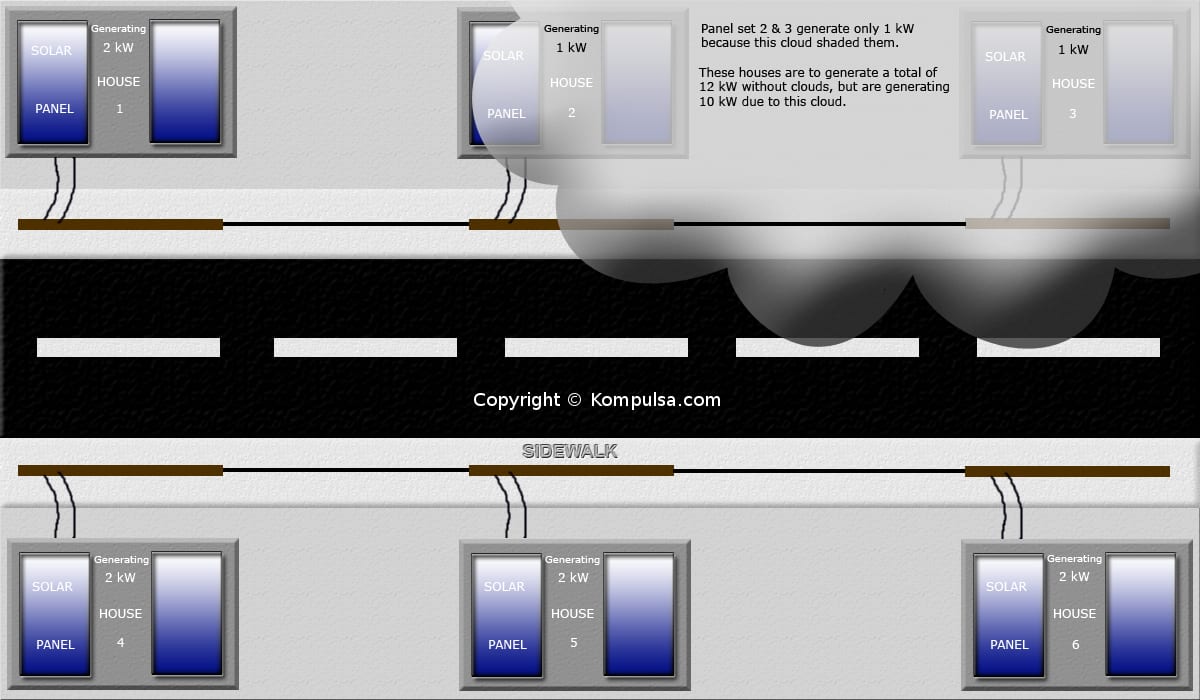
Credit: Kompulsa / Nicholas Brown.
Example case: A large storm passes over a 50 MW solar power plant (photovoltaic, in other words regular solar panels) and is just about large enough to cover it. The plant powers 12,500 homes and there is now a power shortage of 30 MW because the clouds blocked some sunlight from reaching the panels.
This means that another power plant has to provide the 30 MW needed to compensate for that shortage. If the solar power plant mentioned above was replaced with 12,500 rooftop solar panel arrays, then because such residential solar systems are scattered over miles of land and not concentrated in one location like plant mentioned above, most people would still have enough power.
Another advantage of this system is that roof systems require no additional land because they are on roofs instead of the ground. The storm mentioned could cover a neighbourhood and their solar panels, but never all 12,500 houses at once.
Instead of reducing power production enough to leave 7,500 without power, it would affect only several (or more) solar systems in the clouded neighbourhood mentioned and reduce power production enough to leave only several people without power.
Several homes do not require much energy storage. As a matter of fact it is quite cheap compared to the energy storage (batteries, for example) required for 7,500 homes.
Another benefit of such a system is that when the storm moves away from the neighbourhood mentioned, the neighbourhood then generates full (or near) power again and will help to back up the other homes and neighbourhoods that are clouded by that storm.
Large Storms
Particularly large storms can have a significant impact on the power production of a distributed solar power system like the one I mentioned above due to the fact that storms consist of clouds which will shade the solar panels.
This would have to be addressed with backup generators, which is feasible. All power plants will fail or have to be temporarily shut off at some point, they will require backup in the event of breakdowns, for maintenance, etc.
Cost of Backup Solar Panels
One way to back up solar panels in the event of cloudy weather is to purchase more panels to ensure that enough electricity is generated during the day. However, some consider this to be more expensive than fewer panels, and it is not. The payback time is the same, and the cost of electricity is the same. I provided a simplified example below.
Example: If you were to purchase twice as many solar panels to compensate for shortages due to cloudy weather for example, your solar system would generate twice as much electricity, therefore, the overall cost is the roughly same. The reason it is not exactly the same is because economies of scale results in the 400 MW power plant being cheaper.
That is why the cost of electricity from a 200 MW power plant does not cost less than the electricity from a 400 MW power plant. The real or net cost is the entire cost of the generator over its lifetime including maintenance, fuel, etc divided by the amount of electricity that it generates over its lifespan. Whether you use this equation for a 400 MW or a 200 MW power plant, the result is the same.
In the case of a grid-tie solar system (connecting the panels to the electricity grid to offset your electricity usage), if you purchased twice as many panels to ensure that your electricity bill never exceeds a certain amount, then you save twice as much on your electricity bill because the system will generate twice as much electricity, and hence reverse your meter twice as much.