
Electric cars typically consume 25–40 kWh of electricity per 100 miles, depending on the model, driving conditions, and climate. That works out to roughly 0.25–0.40 kWh per mile — a fraction of the energy a gasoline car consumes to cover the same distance. But what that electricity actually costs you depends on where and when you charge, which is why two owners of the same EV can see very different “fuel” bills.
This guide breaks down real-world EV energy consumption, explains how EPA efficiency ratings work, compares home Level 2 charging with public fast charging, and walks through the math of calculating your own cost per mile against a gasoline car.
Quick Answer: How Many kWh Does an EV Use?
Most modern electric cars use between 2.5 and 4 kilowatt-hours for every 10 miles driven. The most efficient sedans on the market dip below 25 kWh per 100 miles, while larger SUVs and trucks with big batteries and less aerodynamic shapes can exceed 40 kWh per 100 miles.
For a driver covering the US average of roughly 13,500 miles per year, that translates to approximately 3,400–5,400 kWh of electricity annually — about the same as a typical household’s total electricity consumption for everything else combined.
How EV Efficiency Is Measured: kWh per 100 Miles and MPGe
Electric vehicle efficiency is expressed two ways:
- kWh per 100 miles — how much electricity the car draws from the wall to travel 100 miles. Lower is better. This is the number that maps directly to your electricity bill.
- MPGe (miles per gallon equivalent) — a comparison metric based on the fact that one gallon of gasoline contains the energy equivalent of 33.7 kWh. An EV that travels 100 miles on 33.7 kWh scores 100 MPGe.
Note: EPA MPGe and kWh/100-mile ratings include charging losses — the energy converted into heat in the charging cable and the car’s onboard charger. That makes them a more realistic reflection of what you’ll actually pay at the meter than the battery’s nominal capacity alone.
Real-World Efficiency: Current Models Compared
Based on EPA data compiled for the model year 2026, here is how some popular EVs compare (combined rating, kWh drawn per 100 miles from the wall):
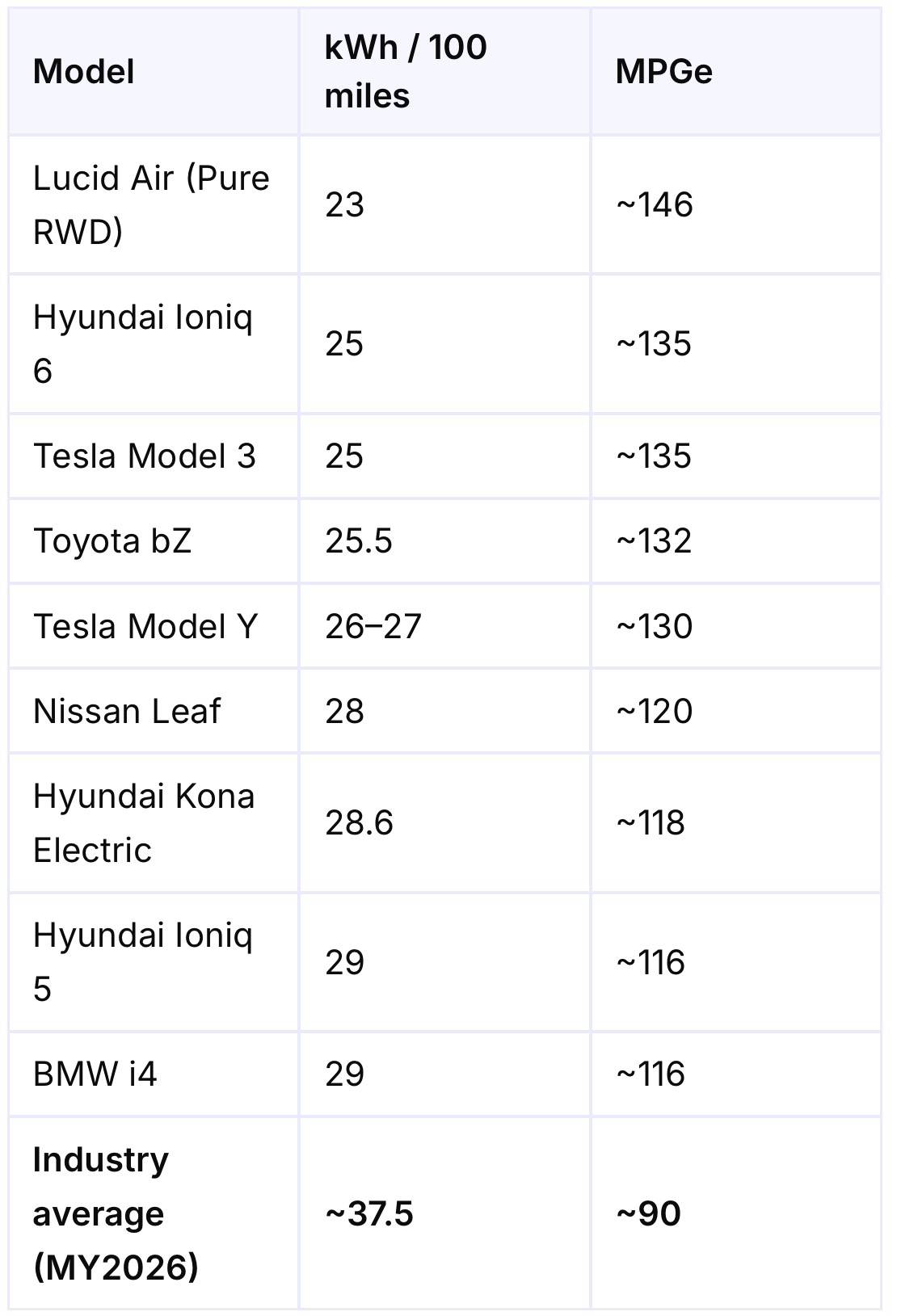
Takeaways: sleek sedans are in the 23–26 kWh/100-mile range; crossovers and SUVs give up 3–6 kWh/100 miles to aerodynamics and weight; and the fleet average is pulled up by large electric trucks and SUVs. Trim choices matter too — bigger wheels alone can cost several percent in efficiency.
(Efficiency figures are EPA combined ratings as compiled by Recurrent and Cars.com for model year 2026; always check the window sticker or fueleconomy.gov for the exact trim you’re considering.)
What Factors Change Real-World Consumption?
EPA ratings are a starting point, not a promise. Real-world consumption varies with:
- Speed — unlike gasoline cars, EVs are more efficient in city driving than on the highway. Aerodynamic drag grows with the square of speed, so sustained 75–80 mph cruising can add 15–25% to consumption.
- Temperature — cold weather is the big one. Cabin heating, battery conditioning, and denser winter air can cut range 20–30% in freezing conditions, raising per-mile consumption accordingly. Preconditioning while still plugged in helps, since that energy comes from the grid rather than the battery.
- Terrain and load — hills, headwinds, cargo, roof racks, and towing all increase consumption. Regenerative braking recovers much (but not all) of the energy used climbing.
- Driving style — aggressive acceleration drains the battery faster than slow, steady throttle inputs.
- Climate control use — An automotive HVAC system can add 1–2 kW of draw. Heated seats and steering wheels use far less energy than cabin air heating and are the smarter first choice in winter.
The Cost Side: Home Charging vs. Public Fast Charging
Home charging (Level 2)
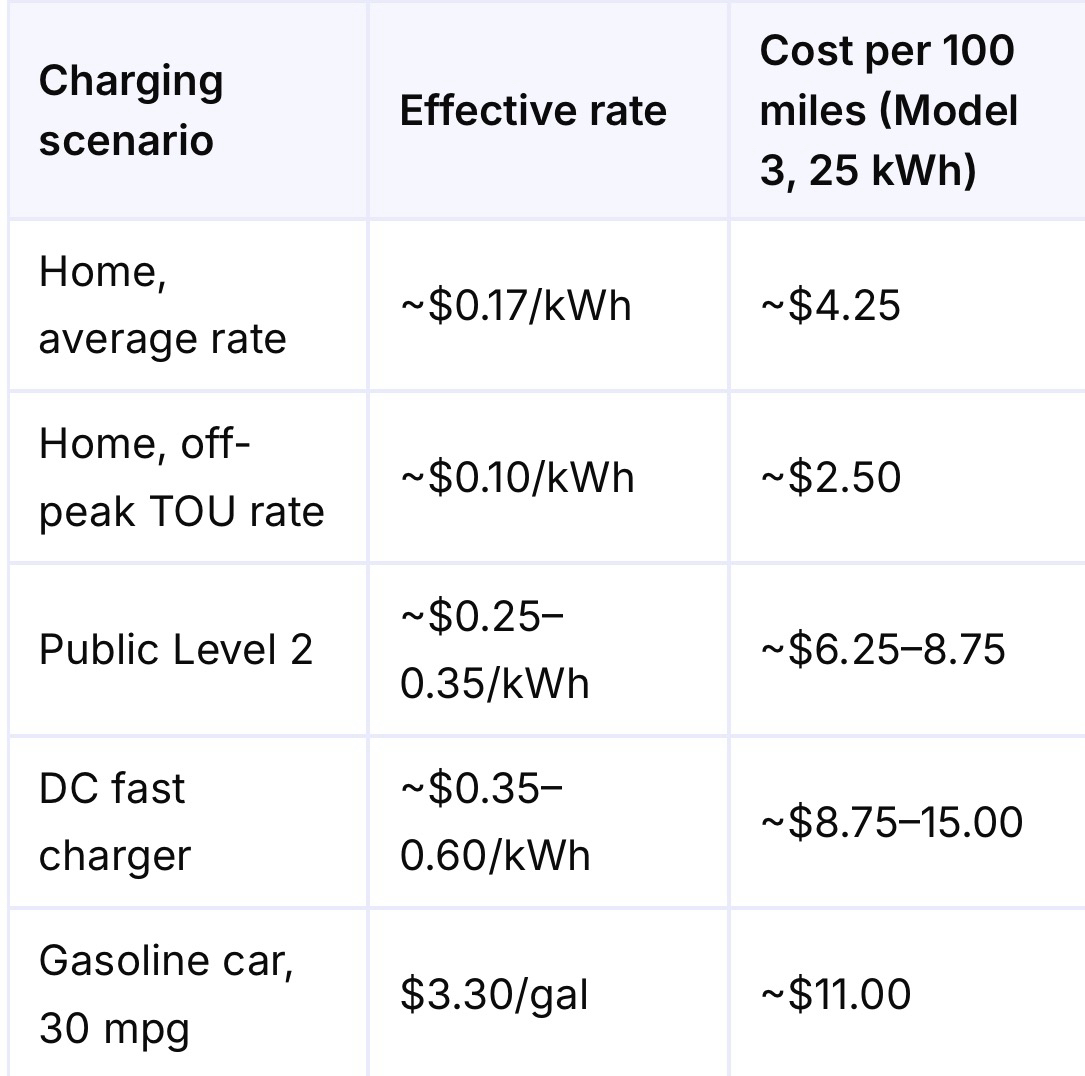
For most owners, home is where 80% or more of charging is done. At the US average residential electricity rate of roughly 17 cents per kWh, the math looks like this:
Example: Tesla Model 3 (25 kWh/100 miles)
- 100 miles × 25 kWh × $0.17 = $4.25 per 100 miles (about 4.3¢ per mile)
- 13,500 miles/year ≈ $575 per year
Example: Large electric SUV (~40 kWh/100 miles)
- 100 miles × 40 kWh × $0.17 = $6.80 per 100 miles (about 6.8¢ per mile)
- 13,500 miles/year ≈ $920 per year
If your utility offers time-of-use rates, charging overnight at an off-peak rate (often 8–13¢/kWh) could reduce these figures by 25–50%. That single change is usually the biggest cost lever an EV owner has.
Public DC fast charging
Public fast chargers usually charge between $0.35–$0.60 per kWh — roughly two to three times the home rate. On that basis, the same Model 3 costs about $8.75–$15.00 per 100 miles at a fast charger, approaching or exceeding the cost of driving an economical gasoline car.
Fast charging is best treated as a road-trip tool, not a lifestyle. Owners who rely on it exclusively lose most of the fuel-cost advantage of EV ownership.
The gasoline comparison
At 30 mpg and a gasoline price of $3.30 per gallon, a conventional car costs about $11.00 per 100 miles. Against home charging at ~$4–7 per 100 miles, that’s a saving of roughly $400–900 per year at average mileage — and more if you charge off-peak.
How to Calculate YOUR Cost Per Mile
You only need three numbers:
- Your EV’s consumption in kWh/100 miles (from the window sticker, fueleconomy.gov, or your car’s trip computer — the trip computer reflects your actual driving).
- Your electricity rate — the all-in cents per kWh on your utility bill. If you’re on time-of-use pricing, use the rate that applies when you actually charge.
- Your monthly or annual mileage.
Formula:
Cost per mile = (kWh per 100 miles ÷ 100) × electricity rate per kWh
Then multiply by your mileage. Example: a 29 kWh/100-mile crossover, charged at $0.17/kWh, driven 1,000 miles a month costs 0.29 × $0.17 × 1,000 ≈ $49 per month.
If you want precision, spend $20–30 on a plug-in energy meter for your Level 2 charger’s circuit, or compare your utility bill before and after EV ownership — the difference is your true charging cost, losses included.
Does an EV Meaningfully Increase Your Electricity Bill?
Yes — expect your bill to grow by roughly the cost of your driving. At 1,000 miles per month in a 27 kWh/100-mile EV at $0.17/kWh, add about $46/month to the bill. Spread over a household’s total energy spending, though, the comparison is favorable: the same 1,000 miles in a 30 mpg gasoline car at $3.30/gallon costs about $110. The EV replaces a large gasoline expense with a smaller electricity one, not an extra one.
FAQ
How much electricity does an EV use per mile?
Between 0.25 and 0.45 kWh per mile for most models. Efficient sedans are near the low end and large trucks and SUVs are near the high end.
How many kWh does it take to charge an EV from empty to full?
For the battery itself, its rated capacity (say 60–100 kWh). From the wall, add 10–15% for charging losses, and a bit more if the battery is cold and the car spends energy conditioning it.
Is it cheaper to charge an EV than buy gas?
Usually, dramatically — at average US rates, home charging costs roughly 40–60% as much per mile as gasoline in a 30 mpg car. The advantage shrinks (or disappears) if you rely on expensive DC fast charging.
How much does it cost to charge an EV at home?
For a typical 250-mile-per-week driver in a mid-size EV at $0.17/kWh: roughly $11–14 per week, or $550–750 per year.
Do EVs use more electricity in winter?
Yes. Heating, battery conditioning, and colder, denser air commonly raise consumption 20–30%. Preconditioning while plugged in and favoring seat heaters over cabin heat mitigates it.
What’s more efficient, kWh/100 miles or MPGe?
They’re two views of the same rating — kWh/100 miles is what your wallet feels, while MPGe makes EV-vs-gas comparisons intuitive. Divide 33,700 by the MPGe figure to convert to Wh per mile.
Related Articles
Refrigerator Power Consumption: Deciphering The Label
Air Conditioner Power Consumption: Deciphering The Label